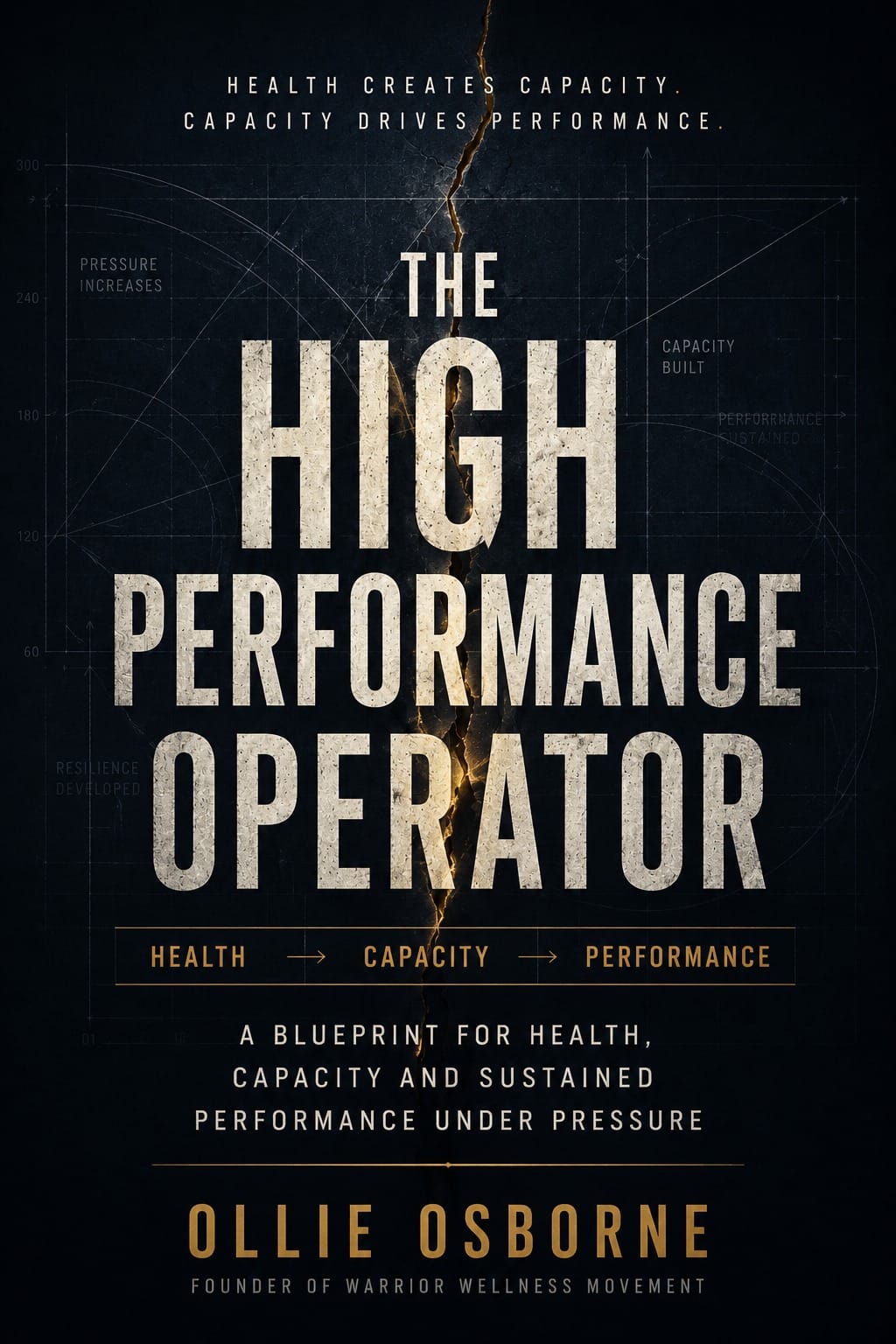
For years I chased performance. It took me far longer to realise what a High Performance Operator actually is.
When I was younger, I thought I understood high performance.
Work harder.
Train harder.
Push further.
Endure more than the person next to you.
If I could keep going when other people stopped, I saw that as evidence I was performing at a high level.
And for a while, it worked.
That mentality helped me through the military, elite sport and some incredibly demanding periods of my life.
The problem was that I had become very good at performing.
I hadn’t become very good at protecting the thing that made performance possible.
It took me years to understand the difference.
We measure the wrong thing
When we talk about high performance, we tend to focus on what we can see.
The athlete winning.
The business owner working 12-15 hour days.
The leader carrying enormous responsibility.
The person who never seems to stop.
We admire the output.
But output only tells us what someone is capable of producing today.
It tells us very little about what it’s costing them.
Someone can perform exceptionally well while sleeping badly.
They can run a successful business while becoming increasingly unfit.
They can lead hundreds of people while having almost nothing left for their family when they get home.
They can hit every target while their energy, health and quality of life quietly deteriorate.
That’s still performance.
But is it really high performance?
I’m not sure it is.
Performance is often the last thing to fail
This became one of the most important realisations of my own life.
We tend to assume that if we’re still performing, everything underneath must be OK.
But human beings are remarkably good at compensating.
Experience compensates.
Caffeine compensates.
Adrenaline, determination and responsibility all compensate.
For a surprisingly long time, you can continue producing visible results while the foundations underneath them are deteriorating.
That’s why performance can be such a misleading measure of how someone is actually doing.
Performance is often the last thing to fail.
Long before that happens, sleep may have changed.
Energy may have fallen.
Fitness may have disappeared.
Body weight may have increased.
Recovery may have deteriorated.
Patience may be shorter.
Relationships may be receiving whatever is left.
But you’re still delivering.
So you assume you’re fine.
This is what I came to understand as Visible Performance. Invisible Decline.
And it completely changed how I thought about high performance.
Health Creates Capacity. Capacity Drives Performance.
Eventually, I realised I’d been looking at the relationship backwards.
Performance isn’t the foundation.
It’s the outcome.
Health Creates Capacity. Capacity Drives Performance.
Your physical, mental and emotional health influence the capacity you have available.
That capacity determines what you can sustainably give to your work, your family, your responsibilities and the things that matter to you.
Performance is what everyone else eventually sees.
Which means protecting performance requires looking much further upstream.
That idea became the philosophy behind Warrior Wellness Movement.
It also eventually gave me the title of my book.
So what actually is a High Performance Operator?
Chapter 35 of The High Performance Operator finally answers the question the title has been asking throughout the book.
And the answer is very different from the one I would have given 20, 10 even 5 years ago.
A High Performance Operator isn’t necessarily the person working the longest hours.
It isn’t the person training the hardest.
It isn’t the person willing to sacrifice everything in pursuit of an outcome.
And it certainly isn’t someone who never struggles.
To me, a High Performance Operator is someone who understands that their ability to contribute tomorrow depends partly on what they protect today.
They know when to push.
But they also know when to recover.
They can operate under pressure without pretending pressure has no cost.
They take responsibility for their health because they understand what depends upon it.
Most importantly, they think beyond the next result.
Because there is a significant difference between being able to perform and being able to continue performing.
Imagine two successful people.
One works relentlessly for ten years, achieves extraordinary things and eventually reaches a point where their health, relationships or ability to continue begin to suffer.
The other achieves at a high level while protecting enough health and capacity to remain energised, engaged and contributing twenty years later.
Which one represents high performance?
I know which one I’d choose today.
Twenty years ago, I’m not sure I would have.
Perhaps we need a different measure
Ambition isn’t the problem.
Working hard isn’t the problem.
Neither is pressure.
There will always be periods when we need to ask more of ourselves.
The mistake is believing that our ability to endure those periods indefinitely is evidence of high performance.
Sometimes it’s evidence that we’re accumulating a cost we haven’t recognised yet.
So perhaps the better question isn’t:
How much can I do?
Perhaps it’s:
How long can I continue doing what matters at the level I expect of myself?
Because if your current approach requires your health to deteriorate in order for your performance to continue, eventually something has to give.
That’s not sustainable performance.
And I don’t think we should call it high performance.
Chapter 35 brings together many of the ideas I’ve explored throughout The High Performance Operator, but ultimately they lead me back to one conclusion.
The ultimate measure of a High Performance Operator isn’t how much they can endure.
It’s how long they can continue to contribute.
So I’m interested:
Who do you consider a true high performer … and why?
Chat soon. Ollie
#TheHighPerformanceOperator #HealthCreatesCapacity #SustainablePerformance #Leadership #WarriorWellnessMovement